When to Replace the Resin Tank in Your System
Resin tanks in Queen Creek last 8 to 15 years. Here's how to tell when yours is failing, what replacement costs in 2026, and when to call a pro.
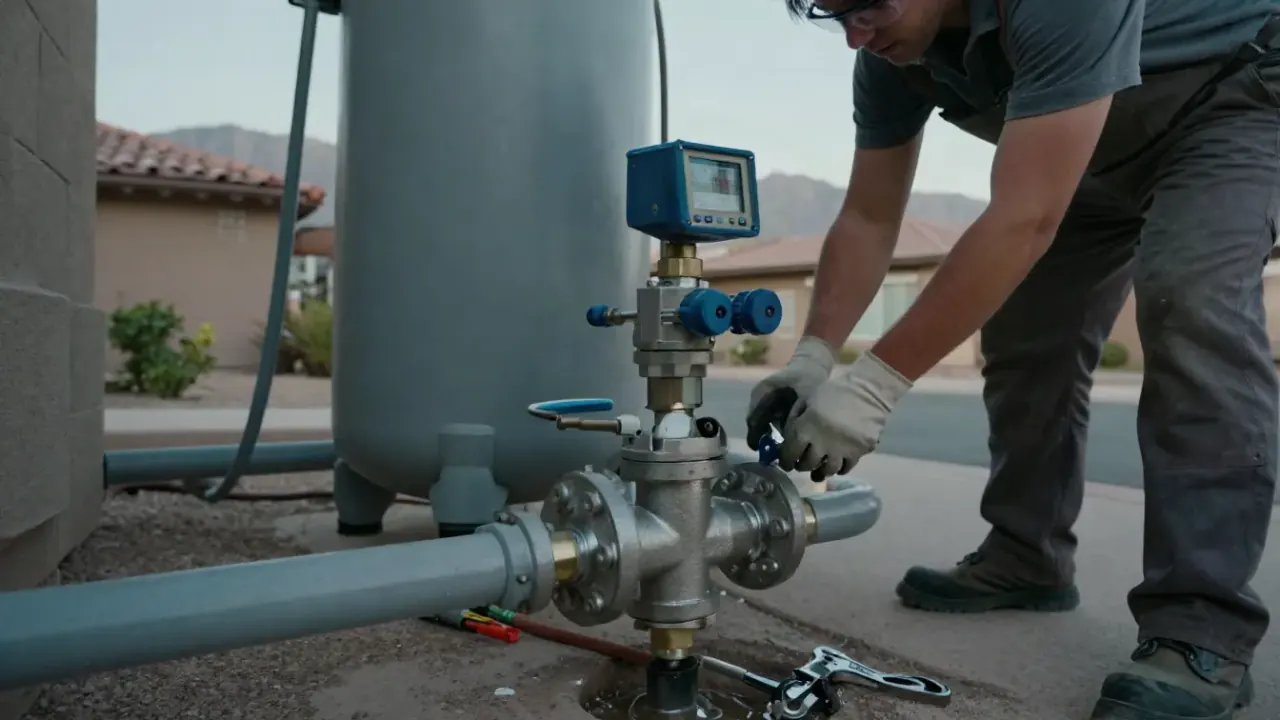
Replace the resin tank in your system when the tank itself is cracked, leaking, or more than 12 to 15 years old, or when softened water tests hard again after you have already replaced the resin. In Queen Creek, most resin tanks hit that wall between year 8 and year 15 because our water runs 12 to 18 grains per gallon of hardness and the resin beads take a beating. This post covers the signs, the lifespan, the 2026 replacement costs, and how to tell a bad tank from a bad valve.
Resin tank replacement is the service that swaps out the fiberglass pressure vessel holding the ion-exchange resin, not just the beads inside it. Homeowners call us about this constantly in Water Softener in Ironwood Crossing and across the East Valley, usually after a softener that worked fine for a decade suddenly stops softening.
What the Resin Tank Actually Does
The resin tank is the fiberglass pressure vessel that holds the ion-exchange resin your softener uses to pull calcium and magnesium out of hard water. Water enters through the control valve on top, flows down through a bed of resin beads, and exits soft. The beads grab hardness minerals and hold them until a brine cycle rinses them off.
The tank itself is not the part that wears out first. The resin is. Beads crack, lose their charge sites, and turn to mush after years of chlorinated municipal water and 100-plus-degree summer heat in a garage. But the tank can fail too, and when it does, you are looking at a flooded garage floor and a softener that does nothing.
Two things kill a resin tank in Arizona: UV and pressure cycling. A tank sitting in a south-facing garage in Queen Creek sees interior temperatures that push past 120 degrees in July. Fiberglass does not love that. Add the daily pressure swings from a municipal system and you get hairline cracks that start small and grow.
How Long Does a Resin Tank Last in Queen Creek?
A water softener resin tank lifespan in Queen Creek Arizona runs 8 to 15 years, with 10 to 12 being the realistic average for a tank in an unconditioned garage. Tanks installed inside a climate-controlled space regularly make it past 15. Tanks in direct sun often fail closer to year 8.
Three factors move that number:
- Water chemistry. Queen Creek water comes from a mix of CAP canal water and groundwater wells. Hardness swings from 12 to 18 grains per gallon depending on the month and which well is feeding your neighborhood.
- Chlorine and chloramine. Both attack resin beads. The Town of Queen Creek treats with chlorine, and that chlorine is in every drop hitting your resin bed.
- Where the tank sits. Garage, exterior pad, or utility closet makes a 4-to-6-year difference in lifespan.
If your softener is more than 10 years old and you have never had the resin tested, that is the first thing we check. A quick Water Hardness Testing Queen Creek AZ visit tells you whether the resin is still doing its job or whether you are pouring salt into a tank that cannot soften anything.
Resin Tank Replacement Signs You Should Not Ignore
Resin tank replacement signs fall into two buckets: things you can see and things you can taste. Visible signs are urgent. Taste and feel signs mean the resin is dying but the tank may still be fine.
Visible signs
- Water pooling at the base of the tank. A cracked tank weeps from the bottom seam or the threaded neck. This is a replace-now situation.
- Orange or rust-colored resin in the brine line. Beads are breaking down and flushing out of the tank. Once you see beads in the drain line, the resin is spent.
- A bulging or deformed tank. Fiberglass does not bulge unless it has been over-pressurized or frozen. Either way, the tank is done.
- Hairline cracks near the valve threads. The most common failure point. Get a flashlight and look at the neck where the control valve screws in.
Performance signs
- Soap will not lather, or lathers weakly, in every faucet.
- White scale reappears on shower glass within a week of cleaning.
- Water heater is popping or rumbling from scale buildup.
- You are adding salt every two weeks instead of every six to eight weeks.
That last one is the tell most homeowners miss. A softener that suddenly eats salt is usually a softener that cannot regenerate properly, and the resin or the tank is the reason. We see this constantly in Water Softener in Queen Creek Station, where a lot of the original builder-grade softeners are now 12 to 14 years old and hitting end of life at the same time.
Resin Tank Failure Symptoms That Look Like Something Else
Resin tank failure symptoms often get misdiagnosed as valve problems, which is why homeowners spend money on the wrong repair. The control valve and the resin tank fail in similar ways from the outside.
Here is how to tell them apart. If the softener is leaking from the top where the valve meets the tank, that is usually a valve or O-ring issue, not a tank issue. If it is leaking from the bottom or the side wall, the tank itself has failed. If the unit runs through a regeneration cycle but the water stays hard, the resin is dead, and the tank may still be fine.
We have pulled tanks that looked perfect on the outside and were full of resin that had turned to brown sludge. We have also pulled tanks that were clearly cracked and had perfectly good resin inside. You cannot tell without opening the unit or testing the output water.
If your softener is running but not softening, the cheapest first step is a hardness test on the treated water. If treated water comes back at 1 to 2 grains per gallon, the resin is working and the problem is elsewhere. If it comes back at 10 or higher, the resin is done.
Can You Replace Just the Resin?
You can replace just the resin in your softener in Queen Creek, and it is often the right call when the tank is under 10 years old and structurally sound. Softener resin replacement costs less than a full tank swap and takes about two hours.
The process is straightforward. We disconnect the control valve, vacuum out the old resin, flush the tank, pour in new resin, and reconnect everything. Then we run a manual regeneration and test the output. You get softened water back the same day.
What you cannot do is replace resin in a tank that is cracked, bulging, or past 15 years. The new resin will not fix a structural failure, and you will be back to square one within a year. That is when you need full Resin Tank Replacement Queen Creek AZ, which includes the new vessel, the resin, and the labor to swap it all out.
One more thing. If your softener is 15-plus years old and the valve is original too, replacing just the resin is throwing good money at a system that is going to fail somewhere else next year. At that point, a full softener replacement usually makes more sense than a resin swap.
What Resin Tank Replacement Costs in Queen Creek
Resin tank replacement cost in Queen Creek AZ runs $650 to $1,400 in 2026 for the tank, resin, and labor on a standard 32,000 to 48,000 grain residential softener. A resin-only swap runs $350 to $600. A full softener replacement runs $1,200 to $2,800 depending on the unit.
What moves the number:
- Tank size. A 48,000-grain tank costs more than a 32,000-grain tank.
- Resin type. Standard 8% crosslink resin is the baseline. Fine mesh or high-capacity resin costs 20 to 30% more.
- Access. A softener in a tight utility closet takes longer than one on an open garage pad.
- Valve condition. If the control head needs work while we are in there, that adds to the ticket.
We quote the job before we start, and the price we quote is the price you pay. No surprise line items after the work is done.
Resin Tank Maintenance That Adds Years
Resin tank maintenance is mostly about keeping the brine side clean and the resin bed from fouling. Do these four things and you can push a tank from 10 years to 14 or 15.
- Clean the brine tank once a year. Salt bridges and sludge keep the softener from regenerating properly, which forces the resin to work harder. A Brine Tank Cleaning Queen Creek AZ visit is cheap insurance.
- Use the right salt. Pellets or solar salt, not rock salt. Rock salt leaves more insoluble junk in the brine tank.
- Do not let the tank sit in direct sun. If your softener is on an exterior pad, shade it or build a small enclosure. UV degrades fiberglass.
- Test the treated water twice a year. A $15 test kit tells you the resin is still working before you notice hard water in the shower.
We also recommend a whole-house carbon filter ahead of the softener if you are on municipal water. Removing chlorine before it hits the resin bed can add 3 to 5 years to resin life. If you do not have one, a Whole-House Water Filtration Queen Creek AZ system pays for itself in resin you do not have to replace.
Common Mistakes We See
The most common mistake is replacing the resin when the tank is the problem, or replacing the tank when the resin is the problem. Both waste money. Diagnose first.
Second mistake: ignoring a slow leak. A resin tank that weeps a cup of water a day does not seem urgent until it has been doing that for six months and your garage floor is stained and your baseboards are swelling. Fix leaks when you find them.
Third mistake: buying a new softener when the tank is fine. We have talked homeowners out of $2,000 replacements more than once because a $400 resin swap solved the problem.
Fourth mistake: skipping the hardness test. Guessing at the cause of hard water is how you end up paying for the wrong repair. Test first, then decide.
Fifth mistake: letting a softener sit unused for months. Resin beds grow bacteria when they sit wet and idle. If you are leaving a house vacant, either keep the softener running or have it drained and prepped.
When to Call a Professional
Call us when you see water at the base of the tank, when treated water tests hard after a recent resin change, or when your softener is past 12 years old and you have never had it serviced. Those three situations cover 90% of the resin tank calls we run.
We handle the diagnosis, the resin swap, the tank replacement, and the valve work if it is needed. One visit, one price, and you know exactly what is wrong before we touch anything. We work all over Queen Creek and the surrounding East Valley, from Water Softener in Hastings Farms to the older neighborhoods closer to Ellsworth and Ocotillo.
If you are not sure whether you need a resin swap or a full tank replacement, call us and we will tell you straight. Sometimes the answer is a $400 repair. Sometimes it is a new softener. We would rather sell you the right fix than the expensive one.
Frequently Asked Questions
When should I replace my resin tank in Queen Creek AZ?
Replace it when the tank is cracked, leaking, bulging, or more than 12 to 15 years old. In Queen Creek, garage heat and 12 to 18 grain hard water push most tanks to failure between year 8 and year 15. If treated water tests hard after a recent resin change, the tank is the likely culprit.
How long does a water softener resin tank last in Queen Creek Arizona?
Eight to 15 years, with 10 to 12 being the realistic average for a tank in an unconditioned garage. Tanks in climate-controlled spaces regularly exceed 15 years. Tanks in direct sun often fail closer to year 8 because UV degrades the fiberglass.
What are signs my resin tank is bad in Queen Creek?
Water pooling at the base, orange or rust-colored resin in the brine line, a bulging tank, hairline cracks near the valve threads, and hard water that returns within days of a cleaning. Any of these means the tank needs to be replaced, not just the resin.
How much does resin tank replacement cost in Queen Creek?
Expect $650 to $1,400 in 2026 for the tank, resin, and labor on a standard 32,000 to 48,000 grain residential softener. A resin-only swap runs $350 to $600. A full softener replacement runs $1,200 to $2,800 depending on the unit and installation conditions.
Can I replace just the resin in my softener in Queen Creek?
Yes, if the tank is under 10 years old and structurally sound. Resin-only replacement costs $350 to $600 and takes about two hours. If the tank is cracked, bulging, or past 15 years, replace the whole tank instead, because new resin will not fix a structural failure.
Get Help with Water Softener in Queen Creek
If your softener is leaking, eating salt, or leaving hard water spots on everything, we can tell you in one visit whether you need a resin swap or a full tank replacement. We work on every major brand and carry the resin and tanks to get it done the same day.
Call Queen Creek Water Softener at (480) 337-3003 to schedule a hardness test and a straight answer on what your system needs.