What to Expect From a Water Hardness Test
A water hardness test takes 15-30 minutes, costs $0-$150, and tells you exactly how hard your Queen Creek water is so you can size a softener correctly.
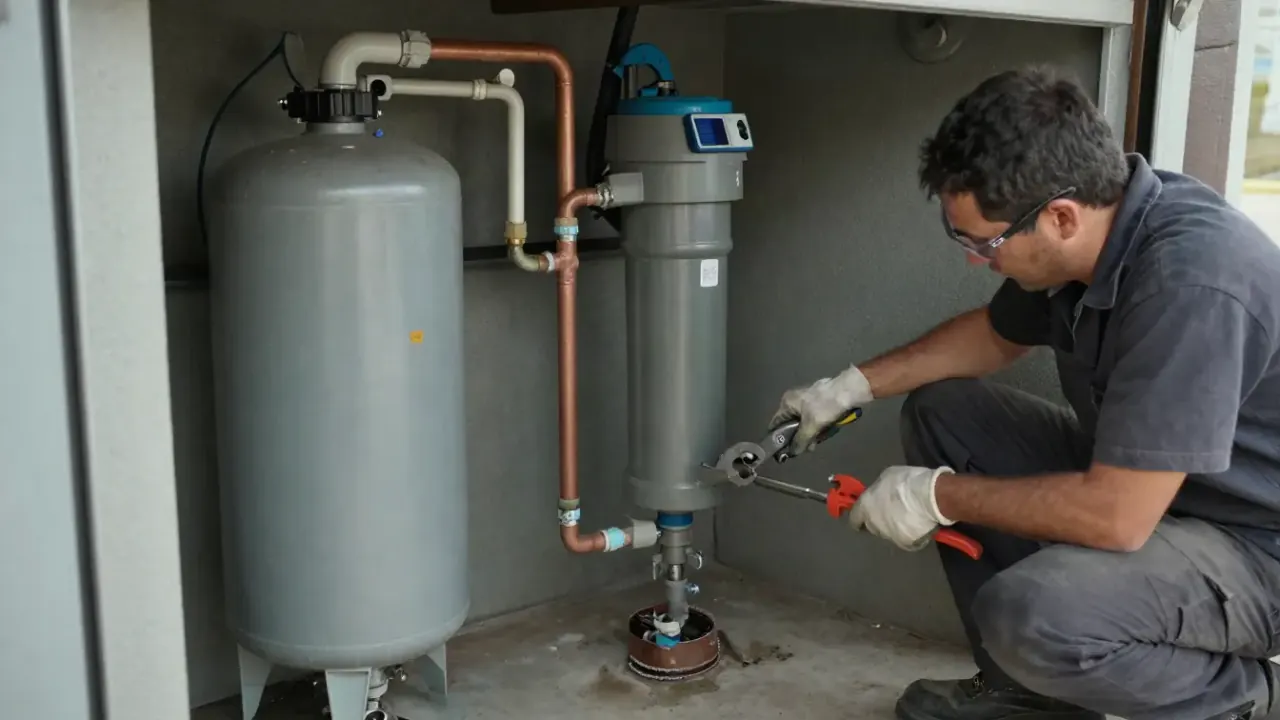
A water hardness test measures the dissolved calcium and magnesium in your water and reports it in grains per gallon (gpg) or milligrams per liter (mg/L). In Queen Creek, that number almost always lands between 12 and 22 gpg - hard enough that a softener is not a luxury, it is the only thing standing between your plumbing and scale. The test itself takes 15 to 30 minutes, costs $0 to $150 depending on who runs it, and gives you the single number you need to size a softener correctly.
Here is what actually happens during the test, how to read the results, what they mean for your home, and where the free options are in Queen Creek.
What Happens During a Water Hardness Test in Queen Creek AZ
A water hardness test in Queen Creek AZ starts with a sample pulled from a cold tap - usually the kitchen sink or an outdoor hose bib - after the line has run for 60 to 90 seconds. That flush matters. Water that has been sitting in the pipes overnight picks up extra minerals from the pipe walls and reads higher than the water your softener will actually treat.
From there, the process depends on who is running it:
- DIY strip or drop kit: You fill a small vial or dip a strip, wait 30 to 60 seconds, and match the color to a chart. Total time: under 5 minutes.
- In-home professional test: A technician pulls the sample, runs a titration or digital meter on site, checks your incoming water pressure (Queen Creek homes typically run 60-80 psi), and logs the result. Total time: 15 to 30 minutes.
- Lab test: You collect a sample in a provided bottle, mail it in, and get a full mineral panel back in 5 to 10 business days. Useful if you also want to check for iron, manganese, or arsenic.
For most Queen Creek homeowners, the in-home test is the sweet spot. You get a number you can trust the same day, and you get a technician standing in your garage who can tell you whether the softener you already own is sized right. If you want that done properly, Water Hardness Testing Queen Creek AZ is the service we run most often, and it is free with any softener installation.
How Water Hardness Testing Works: The Three Methods
How water hardness testing works comes down to one chemical reaction: a reagent binds to calcium and magnesium ions, and the amount of reagent used tells you how much hardness was in the sample. The three methods you will run into in Queen Creek are:
1. Test strips
You dip a strip, shake off the excess, wait 15 seconds, and compare the color to a scale. Strips read in 0-25 gpg increments, usually in steps of 2.5 gpg. They are cheap - $10 to $20 for a 50-count bottle - and fine for a rough check. They are not fine for sizing a softener, because a strip that reads "15 to 17 gpg" does not tell you whether you need a 32,000-grain or 48,000-grain unit.
2. Titration drop kits
You add drops of reagent to a measured water sample until the color shifts from red to blue. Each drop equals one grain. A titration kit runs $20 to $40 and gets you within 1 gpg - accurate enough for softener sizing if you follow the instructions exactly. The catch is the endpoint. If you stop at the first hint of purple instead of waiting for full blue, you will read 2 to 3 gpg low.
3. Digital meters and on-site titration
Professional water hardness testing uses a digital photometer or a calibrated titration setup that reads to 0.5 gpg. This is what we use on every in-home test. It removes the color-matching guesswork and gives you a number you can hand to a softener sizing calculator without second-guessing it.
How Long Does a Water Hardness Test Take in Queen Creek?
A professional in-home water hardness test in Queen Creek takes 15 to 30 minutes from knock to handshake. A DIY strip takes under 5 minutes. A mail-in lab test takes 5 to 10 business days for results.
The 15-to-30-minute window assumes the technician can reach a cold tap and your water heater or softener loop without moving furniture. If you are on a shared well or a private system, add 10 minutes for a second sample at the pressure tank. We pull two samples on well properties because hardness can vary 3 to 5 gpg between the well head and the kitchen faucet.
If you are also getting a quote for a new softener, block 45 to 60 minutes. The test is quick; the sizing conversation and the walk-through of your current setup are what take the extra time.
Water Hardness Test Cost Queen Creek Arizona
Water hardness test cost in Queen Creek Arizona ranges from $0 to $150 in 2026, depending on who runs it and how detailed the report is.
- Free in-home test: $0 when it is bundled with a softener quote or installation. This is the most common path for Queen Creek homeowners.
- Standalone professional test: $75 to $150. You are paying for the technician's time and the calibrated meter, not the reagent.
- DIY strip or titration kit: $10 to $40 at any hardware store or online.
- Mail-in lab panel: $40 to $120, plus shipping. Worth it if you want iron, manganese, arsenic, and TDS in the same report.
We do not charge for a hardness test when we are already out for a softener quote. If you just want the number and nothing else, we will still run it - call ahead so we can put you on the schedule.
How to Read Water Hardness Test Results in Queen Creek
How to read water hardness test results in Queen Creek comes down to one scale: 0-3 gpg is soft, 3.5-7 gpg is moderately hard, 7.5-10.5 gpg is hard, and anything above 10.5 gpg is very hard. Queen Creek municipal water typically tests between 12 and 18 gpg. Private wells in the area run 15 to 22 gpg, with iron showing up in about a third of the wells we test.
If your report gives you mg/L instead of gpg, divide by 17.1. A reading of 240 mg/L is 14 gpg. Most labs report both, but if you only get one, that is the conversion.
Two numbers matter more than the rest:
- Hardness in gpg. This is the number you use to size the softener.
- Iron in ppm (if you are on a well). Anything above 0.3 ppm changes the softener recommendation. Iron fouls resin faster, and a standard softener will struggle if you do not account for it.
Ignore the pH and TDS numbers for softener sizing. They matter for other treatment decisions, not this one.
Using Test Results for Water Softener Sizing in Queen Creek
Water hardness test for water softener sizing in Queen Creek uses three inputs: your hardness in gpg, your household size, and your daily water use. A family of four in Queen Creek uses roughly 300 gallons per day. Multiply 300 gallons by 15 gpg and you get 4,500 grains per day. Multiply that by 7 days and you need a softener rated for at least 31,500 grains per week between regenerations.
That is why the 32,000-grain unit is the default for a four-person Queen Creek household on municipal water. A two-person home on 12 gpg can get away with 24,000 grains. A five-person home on 18 gpg needs 48,000 grains. Guessing at this is how people end up with a softener that regenerates every other day and burns through salt.
If your test comes back above 18 gpg or your iron is elevated, we usually pair the softener with a whole house water filter Queen Creek ahead of the resin tank. The filter pulls iron and sediment; the softener handles the calcium and magnesium. Running both is cheaper over ten years than replacing resin every three.
If your existing softener is already struggling - salty taste, hard water coming back, or a resin tank that is 10-plus years old - the test will tell you whether the problem is sizing or spent resin. In most cases it is resin, and resin tank replacement Queen Creek is a same-day fix that costs far less than a new system.
Common Mistakes We See With Home Water Hardness Test Kits
Home water hardness test kits fail in predictable ways. Here is what we see on callbacks in Queen Creek:
- Testing water that sat in the pipes. A first-draw sample reads 2 to 4 gpg higher than a flushed sample. Run the cold tap for 90 seconds first.
- Testing hot water. Heat skews the reagent. Always test cold.
- Stopping the titration early. If the color is purple, you are not done. Wait for full blue.
- Using an expired strip. Strips have a shelf life of about 12 to 18 months. If the bottle has been in a hot garage since last summer, the reading is meaningless.
- Testing at the softener outlet instead of the inlet. If you want to know how hard your source water is, sample before the softener, not after.
- Trusting a single sample. Hardness in Queen Creek shifts 1 to 3 gpg between summer and winter because of blending at the municipal source. One test in July is a snapshot, not a year-round number.
If you want a number you can size a system on, get it from a calibrated meter. A $15 strip is fine for a yes-or-no answer. It is not fine for a $2,000 decision.
When to Call a Professional
Call a professional when you are sizing a new softener, when your current softener is not keeping up, or when you are on a private well and need iron and hardness tested together. Those three situations are where a $15 strip costs you real money.
We run free in-home hardness tests across Queen Creek and the surrounding communities. If you are in one of the newer builds off Riggs Road, we are in Hastings Farms water softener installs most weeks and know exactly what the water looks like out there. Same story in the older sections of town - the Queen Creek Station water softener calls we get usually involve a 10-plus-year-old unit that was sized for a smaller household than the one living there now.
Our technicians carry a calibrated meter on every truck. We test, we show you the number, and we tell you what it means for your house - no pressure, no upsell if your current system is fine.
Frequently Asked Questions
What happens during a water hardness test in Queen Creek AZ?
A technician pulls a cold-water sample after a 60-90 second flush, runs it through a calibrated titration or digital meter, and gives you a hardness reading in gpg. The whole visit takes 15 to 30 minutes. If you are on a well, we pull a second sample at the pressure tank.
How much does a water hardness test cost in Queen Creek Arizona?
Zero to $150 in 2026. It is free when bundled with a softener quote or installation. A standalone professional test runs $75 to $150. DIY strips cost $10 to $40, and a mail-in lab panel runs $40 to $120 plus shipping.
How accurate are home water hardness test kits in Queen Creek?
Strips are accurate to about 2.5 gpg - fine for a rough check, not for sizing a softener. Titration drop kits get within 1 gpg if you follow the endpoint exactly. Calibrated meters used by professionals read to 0.5 gpg, which is what you want before spending money on a system.
Where can I get a water hardness test near me in Queen Creek?
We run free in-home tests across Queen Creek, San Tan Valley, and Gilbert. Hardware stores sell strips and drop kits if you want a quick DIY read. For a full mineral panel including iron and arsenic, a mail-in lab is the option - but start with the in-home test.
What do water hardness test results mean in Queen Creek?
Anything above 10.5 gpg is very hard, and most Queen Creek water tests 12 to 18 gpg. That means a softener is the right call for nearly every household here. The number also tells you what size softener you need - a four-person home at 15 gpg needs at least 32,000 grains.
Get Help With Water Softener in Queen Creek
If you want to know exactly how hard your water is before you spend a dollar on a softener, we will come out and test it for free. We serve Queen Creek and the surrounding East Valley, and we will tell you straight whether you need a new system or just a resin change.
Call Queen Creek Water Softener at (480) 337-3003 to schedule your test.