Is Reverse Osmosis Worth It for Drinking Water?
Queen Creek tap water runs 12-18 grains per gallon of hardness and carries TDS from the CAP canal. Here's whether an RO system is worth it for your kitchen.
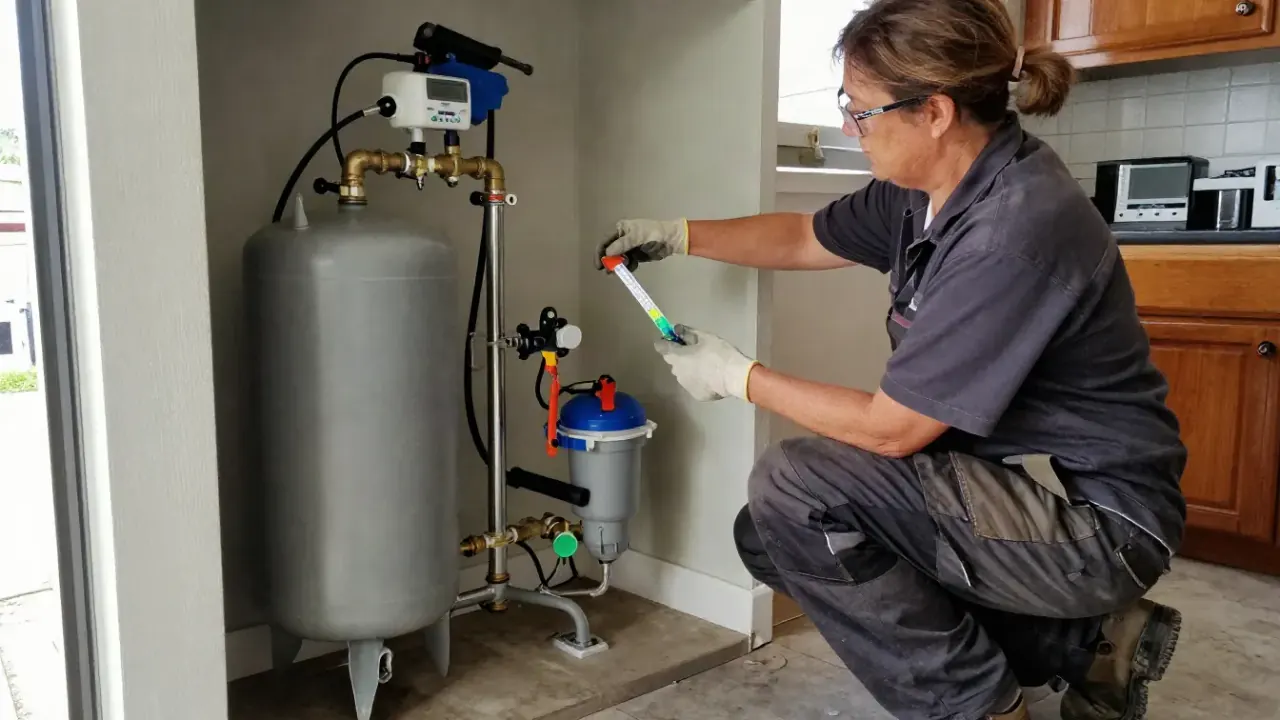
Yes, reverse osmosis is worth it for drinking water in Queen Creek if your household drinks more than a few gallons a week and you want to stop hauling bottled water. A quality under-sink RO system costs $400-$1,200 installed in 2026, filters out 90-99% of dissolved solids, and pays for itself in 12-24 months against bottled water. The rest of this post breaks down what's actually in Queen Creek tap water, what RO removes, what it leaves behind, and how to tell whether your kitchen is a good fit.
Is reverse osmosis worth it for drinking water is a question we get almost every week from homeowners moving into new builds off Ellsworth and Ocotillo. The honest answer depends on three things: your water source, your drinking habits, and whether you're already dealing with hard water damage on your fixtures. We'll cover all three.
The Short Answer: Yes, With Three Conditions
Reverse osmosis is a filtration process that pushes water through a semi-permeable membrane to strip out dissolved solids, heavy metals, and contaminants smaller than 0.0001 microns. It's the same technology bottled water companies use, just scaled down to fit under your sink.
Three conditions make RO worth the money in Queen Creek:
- You drink tap or filtered water daily. If your household goes through 2+ gallons a day, an RO system beats bottled water on cost within the first year.
- You're on municipal water with elevated TDS. Queen Creek's water runs 400-700 ppm total dissolved solids depending on the blend from CAP and groundwater wells. RO drops that to 20-50 ppm.
- You want consistent taste. RO removes the chlorine, chloramine, and mineral load that makes Queen Creek water taste flat or metallic in summer.
If you're on a private well, RO is even more valuable because you're also filtering agricultural runoff and naturally occurring minerals that municipal treatment doesn't touch.
What Queen Creek Tap Water Actually Contains
Queen Creek tap water is a blend of Colorado River water delivered via the Central Arizona Project canal and local groundwater pulled from wells in the Upper Santa Cruz basin. That blend changes seasonally, which means your water quality changes too.
Here's what we measure on a typical Queen Creek sample:
- Hardness: 12-18 grains per gallon (205-308 mg/L as calcium carbonate). That's very hard - anything above 10 gpg is considered hard, and above 14 is very hard.
- Total dissolved solids (TDS): 400-700 ppm. The EPA recommends keeping drinking water under 500 ppm for taste.
- Chlorine/chloramine: 0.5-2.0 ppm residual at the tap. Necessary for disinfection, unpleasant in a glass.
- pH: 7.4-8.2, slightly alkaline. That alkalinity accelerates scale buildup in water heaters and fixtures.
- Arsenic: typically under 5 ppb in municipal water, but private wells in the area have tested above the 10 ppb federal limit.
That hardness number matters because it's the same water feeding your showerheads, dishwasher, and water heater. If you've noticed white crust on faucets or spots on glasses straight out of the dishwasher, you're seeing calcium carbonate at work. A water hardness test Queen Creek takes 10 minutes and tells you exactly what you're working with before you spend a dollar on filtration.
For most Queen Creek households, the smart play is a two-stage approach: soften the whole house to protect your plumbing and appliances, then polish the drinking water at the kitchen sink with RO. We install both, and we'll tell you honestly if you only need one.
Reverse Osmosis Pros and Cons for Queen Creek Homes
Reverse osmosis pros and cons break down cleanly when you look at what you're actually buying: better-tasting water, fewer contaminants, and a predictable monthly cost - versus water waste, filter changes, and the minerals you lose along the way.
Pros
- Removes 90-99% of TDS. That includes lead, arsenic, nitrates, chromium-6, and the dissolved solids that make Queen Creek water taste heavy.
- Cheaper than bottled water by year two. A family of four spending $40/month on bottled water spends $480/year. An RO system costs $150-$250/year in filters.
- Always available. No trips to Costco, no plastic jugs taking up garage space, no running out mid-week.
- Better for cooking and coffee. Low-TDS water extracts flavor more cleanly. Ask anyone who's switched - their coffee tastes different.
- Reduces plastic waste. A family of four replaces roughly 1,500 plastic bottles a year with one RO system.
Cons
- Water waste. Traditional RO systems send 3-4 gallons to drain for every gallon produced. Modern units with permeate pumps cut that to 1:1 or better.
- Strips beneficial minerals. RO removes calcium and magnesium along with the bad stuff. Most people get those minerals from food, not water, but it's worth knowing.
- Filter changes are mandatory. Skip them and the membrane fouls, the taste degrades, and you're drinking water that's no cleaner than tap.
- Slow fill rate. A standard 50 GPD membrane takes 2-3 hours to refill a 3-gallon tank. Fine for drinking and cooking, not fine if you're filling a pitcher every 20 minutes.
- Needs decent incoming water quality. If your water is very hard or high in iron, the RO membrane clogs fast. That's why we usually recommend softening first.
If you're weighing RO against a whole-house approach, the honest split is this: RO handles drinking water, and a whole house water filter Queen Creek handles everything else - showers, laundry, dishes, water heater protection. Most Queen Creek homes benefit from both, but if you can only do one right now, start with the one that solves your biggest complaint.
RO System Cost vs Bottled Water in Queen Creek, Arizona
RO system cost vs bottled water in Queen Creek, Arizona comes down to simple math: bottled water runs $0.50-$1.50 per gallon, while RO water costs $0.03-$0.08 per gallon once the system is installed. That's a 10-20x difference.
Here's what you'll actually pay in 2026 for an under-sink RO system in Queen Creek:
- Entry-level 4-stage RO: $400-$600 installed. 50 GPD, 3-gallon tank, basic sediment/carbon/membrane/post-carbon setup.
- Mid-range 5-stage with permeate pump: $650-$950 installed. 75-100 GPD, better waste ratio, faster recovery.
- Premium tankless or high-capacity: $1,000-$1,500 installed. 200+ GPD, no storage tank, ideal for large families or home offices.
- Annual filter cost: $80-$180 depending on stage count and water quality.
- Membrane replacement: $40-$80 every 2-3 years.
Compare that to bottled water: a family of four drinking the recommended 64 oz per person per day goes through about 8 gallons a week. At $1.00 per gallon delivered, that's $416 a year. At Costco pricing of $0.30 per gallon, it's $125 a year - but you're still hauling it, storing it, and recycling the plastic.
An reverse osmosis system Queen Creek installed at the mid-range price pays for itself in 18-24 months against delivered water and in 4-6 years against bulk bottled water. After that, you're saving $150-$400 a year, every year, for the life of the system.
One more number worth knowing: a 2026 study from the Environmental Working Group found that bottled water can contain many of the same contaminants as tap water, just without the disclosure requirements. RO gives you control over what's actually in your glass.
Is RO Water Good for You? What It Removes and What It Leaves
Is RO water good for you? Yes - it's as safe or safer than bottled water, and it removes contaminants that municipal treatment doesn't fully address. What it doesn't do is add anything back, and that's the part people ask about.
RO removes:
- Lead (90-98% rejection)
- Arsenic (90-95%)
- Nitrates (85-95%)
- Chromium-6 (90-97%)
- Fluoride (85-92%)
- Sodium (85-95%)
- Copper, cadmium, and other heavy metals
- Pharmaceutical residues (70-90%, depending on molecular weight)
- Microplastics (99%+)
What it leaves behind: water. That's the point. If you want minerals back in your glass, you can add a remineralization cartridge for $30-$60 that puts calcium and magnesium back in after the membrane. Some people like the taste better that way. Most don't bother.
The minerals you'd lose from water - calcium, magnesium, potassium - you get far more of from food. A single cup of spinach has more calcium than 8 glasses of tap water. So the "RO strips your minerals" concern is real but overstated.
What matters more is what RO keeps out. Queen Creek sits in an area where arsenic occurs naturally in groundwater. Municipal systems treat for it, but private wells don't get that treatment. If you're on a well, RO isn't a luxury - it's the simplest way to get consistent water quality without testing every month.
Reverse Osmosis Maintenance Cost in Queen Creek
Reverse osmosis maintenance cost in Queen Creek runs $100-$200 a year for filters and $40-$80 every 2-3 years for the membrane. That's it. No service calls required if you're comfortable swapping cartridges yourself.
Here's the schedule we recommend for Queen Creek water:
- Sediment pre-filter: every 6-12 months. Queen Creek water carries fine sediment from the CAP canal that clogs this fast.
- Carbon pre-filter: every 6-12 months. Removes chlorine before it hits the membrane.
- RO membrane: every 2-3 years. Longer if you have a softener upstream.
- Post-carbon filter: every 12 months. Polishes taste.
- Storage tank: inspect annually, replace every 5-7 years if you notice slow flow or low pressure.
If you're on hard water without a softener, cut those intervals by 30-40%. Hard water scales the membrane, and a scaled membrane stops rejecting TDS. That's why we almost always pair an RO system with a softener or a salt-free water conditioner Queen Creek - it extends membrane life and keeps your maintenance costs predictable.
For homeowners who'd rather not think about it, we offer annual service that includes filter changes, membrane testing, and a TDS reading at the tap. One visit, one price, done.
What to Watch Out For With Cheap RO Systems
Cheap RO systems are the most common source of "RO didn't work for me" complaints. The problem is rarely the technology - it's undersized membranes, no permeate pump, and filters nobody replaces.
Watch for these:
- No TDS meter included. If you can't measure what's coming out, you're guessing. A $15 inline TDS meter tells you when the membrane is done.
- 50 GPD membrane with no storage tank upgrade. You'll wait 3 hours for a gallon. Fine for one person, frustrating for a family.
- Proprietary cartridges. Some brands lock you into $80 filters that cost $12 to make. Check filter pricing before you buy the system.
- No permeate pump. Without one, you're wasting 3-4 gallons per gallon produced. With one, it drops to 1:1. That's a 300% difference in water waste.
- Installed without a shutoff valve. If the tank fills and the system doesn't shut off, you're sending water down the drain 24/7.
We've pulled systems installed by big-box contractors that were plumbed into the hot water line, draining into a dishwasher loop, or missing the drain saddle entirely. The fix is usually $150-$300 in parts and an hour of labor. The lesson is simpler: buy the right system once.
If you're in one of the newer neighborhoods like Harvest water softener territory, your home may already have a loop roughed in for a softener but not for RO. We handle both in a single visit.
When to Call a Professional
Call a professional when your water tastes off after a filter change, when your RO system runs constantly, or when you're not sure whether the problem is the RO unit or the water feeding it. Those three symptoms cover 80% of the service calls we run.
We also get called when homeowners want the whole picture - softener, RO, and water heater protection - sized correctly for their actual water. Guessing at cartridge sizes and membrane ratings gets expensive fast.
Queen Creek Water Softener installs and services RO systems across Queen Creek and the surrounding East Valley. We test your water first, recommend the right system for your household size and water chemistry, and handle the install in a single visit. If you already have an RO system that's underperforming, we'll diagnose it and tell you whether it's worth repairing or replacing.
Frequently Asked Questions
Is reverse osmosis worth it for drinking water in Queen Creek AZ?
Yes. Queen Creek water runs 400-700 ppm TDS and 12-18 gpg hardness, and RO drops TDS to 20-50 ppm. For households drinking 2+ gallons a day, an RO system pays for itself in 12-24 months against bottled water.
Is RO water healthy to drink in Queen Creek Arizona?
Yes. RO water meets or exceeds bottled water standards and removes 90-99% of dissolved contaminants, including arsenic and lead that occur naturally in this area's groundwater. You get minerals from food, not water.
How much does a reverse osmosis system cost in Queen Creek?
Installed pricing in 2026 runs $400-$600 for entry-level 4-stage systems, $650-$950 for mid-range units with a permeate pump, and $1,000-$1,500 for tankless high-capacity systems. Annual filters add $80-$180.
Does reverse osmosis remove minerals from water in Queen Creek?
Yes, RO removes calcium, magnesium, and other dissolved minerals along with contaminants. If you want them back, a $30-$60 remineralization cartridge adds calcium and magnesium after the membrane.
How often do I change RO filters in Queen Creek AZ?
Sediment and carbon pre-filters every 6-12 months, post-carbon every 12 months, and the RO membrane every 2-3 years. If you're on hard water without a softener, shorten those intervals by 30-40%.
Get Help With Water Softener in Queen Creek
If you want a straight answer on whether RO makes sense for your kitchen - and what it'll cost to do it right - we'll test your water and give you a written price before we start. No pressure, no upsell, just the numbers for your house.
Call Queen Creek Water Softener at (480) 337-3003 to schedule your water test and RO consultation.