How Scale Buildup Shortens Water Heater Life
Hard water scale coats your water heater's tank and heating elements, forcing it to work harder and die years early. Here's how to spot it and stop it in Queen Creek.
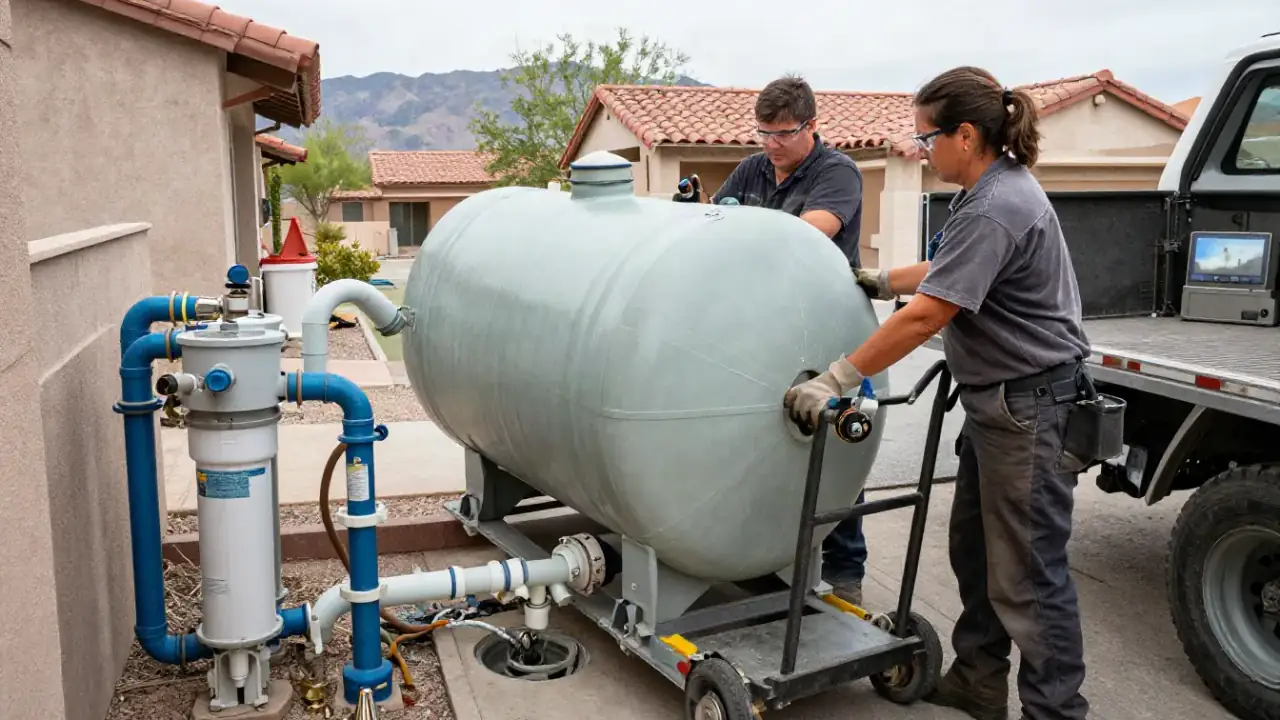
Scale buildup shortens water heater life by insulating the tank and heating elements with rock-hard calcium carbonate, which forces the unit to run longer and hotter to deliver the same hot water. In Queen Creek, where water hardness routinely runs 15 to 25 grains per gallon, that extra strain can cut a water heater's service life from 10-12 years down to 5-7. This post explains exactly what happens inside the tank, how to spot the warning signs, what descaling costs in 2026, and how to stop the damage before you're replacing a heater you shouldn't have to.
What Scale Buildup Does Inside a Water Heater
Scale buildup water heater damage starts the moment hard water enters the tank. Every gallon of Queen Creek tap water carries dissolved calcium and magnesium. When that water heats, those minerals precipitate out of solution and stick to the hottest surfaces they can find - the heating elements in an electric unit, the burner plate and flue in a gas unit, and the interior walls of the tank itself.
The result is a layer of limescale that grows about 1/16 inch thick for every year of hard-water service. That doesn't sound like much until you realize limescale insulates roughly 4,000 times better than steel. A heating element that used to transfer heat directly into the water now has to push that heat through a mineral blanket first.
Three things happen next:
- Elements overheat. The element itself runs hotter because the heat can't escape into the water fast enough. On electric heaters, this is what eventually causes the element to burn out or the high-limit switch to trip.
- The tank works harder. Recovery time stretches from 20 minutes to 40 or more. The burner or element runs longer on every cycle, which accelerates wear on every component.
- Sediment piles up on the bottom. Flakes of scale break off and settle into a rocky layer under the lower element. You hear it as popping, crackling, or rumbling - the sound of water trapped under sediment flashing to steam.
None of this is visible from outside the tank. By the time most homeowners notice a problem, the damage has been compounding for two or three years.
Why Queen Creek Water Is Especially Hard on Water Heaters
Queen Creek pulls most of its water from the Colorado River via the Central Arizona Project canal and from local groundwater wells, and both sources are mineral-heavy. Published water quality reports for the area put total hardness between 15 and 25 grains per gallon - that's classified as very hard water, roughly three to four times harder than what you'd see in Seattle or Portland.
Two local factors make it worse than the raw number suggests. First, groundwater wells in the East Valley tend to run harder than the surface water, and the blend shifts seasonally. Second, summer inlet water temperatures climb into the 80s and 90s, and warm water precipitates scale faster than cold water. That means your water heater is building scale fastest during the exact months you're asking it to work hardest.
We see the pattern across the whole East Valley. Homeowners searching for a Gilbert water softener are dealing with the same 18-grain water we are, and the water heaters in those homes fail on the same accelerated timeline. If you've already replaced one heater in under eight years, the water is the reason.
If you want to know your exact number before you spend a dollar on equipment, start with a water hardness test Queen Creek. We test at the tap and at the water heater drain, and the two readings tell us how much scale has already formed inside the tank.
Signs of Scale Buildup in Your Water Heater
Signs of scale buildup in a water heater show up in the water, the sounds, and the utility bill before they show up as a leak. Here's what to watch for, roughly in the order they appear:
- Popping or rumbling. The most reliable early warning. It's steam escaping through the sediment layer on the tank floor.
- Hot water runs out faster. A 50-gallon tank that used to fill a tub now gives you 15 minutes of hot water instead of 25.
- Recovery time stretches. Time how long the burner runs after a shower. If it's over 30 minutes for a standard 40-gallon tank, scale is stealing capacity.
- Discolored or gritty hot water. Scale flakes in the hot water - but not the cold - mean the tank is shedding mineral debris.
- Higher gas or electric bills. A scaled heater uses 10 to 20 percent more energy to produce the same hot water. You'll see it on the bill before you see it anywhere else.
- Rusty water or a wet floor. Late-stage. Scale has cracked the glass lining or the tank has corroded through. At this point the heater is done.
If you catch the first three signs, descaling can add years back to the unit. If you're at sign six, no amount of cleaning will save it.
How Much Life You Actually Lose
Scale reduces water heater lifespan by roughly 3 to 6 years in Queen Creek's water, and the loss compounds the longer scale sits. A tank-style heater that should last 10 to 12 years in soft water typically fails at 6 to 8 years here. Tankless units are even more sensitive - the heat exchanger narrows with scale, and a scaled tankless heater can lose 40 percent of its flow rate in three years.
The math on replacement is what gets people's attention. A 50-gallon gas water heater installed in Queen Creek runs $1,400 to $2,200 in 2026, depending on venting, code upgrades, and whether the old unit needs a permit. Tankless replacements run $3,500 to $5,500 installed. If scale is cutting four years off every heater you buy, you're paying for an extra heater every decade - money that a softener would have saved.
There's also a warranty angle most homeowners miss. Most manufacturers require annual flushing, and a tank full of rock-hard scale is visible evidence that it didn't happen. That's grounds for a denied claim on a unit that failed at year five.
Water Heater Descaling: What It Costs in Queen Creek
Water heater descaling cost in Queen Creek Arizona runs $150 to $350 for a standard tank flush and element cleaning, and $250 to $500 for a tankless descaling service that circulates vinegar or a commercial descaler through the heat exchanger. Those are 2026 prices for a single visit.
What you get for that money:
- Full drain and flush of the tank to remove sediment
- Pulling and inspecting the lower heating element or burner assembly
- Descaling the element or heat exchanger
- Replacing the anode rod if it's more than half consumed
- Testing the T&P valve and thermostat calibration
Descaling buys you time, but it's a maintenance expense, not a fix. If you're descaling every year at $250, you're spending $2,500 over ten years to keep a heater alive that hard water is still actively destroying. That's why we usually recommend treating the water instead of treating the symptom. Our water heater descaling Queen Creek AZ service handles the cleanup, and a softener handles the cause.
Common Mistakes That Make Scale Worse
The biggest mistake is treating the water heater as a standalone appliance instead of the endpoint of a whole-house water problem. Here's what we see go wrong most often:
- Flushing once and calling it done. Scale reforms continuously. A single flush in year three doesn't protect years four through ten.
- Turning the thermostat up to compensate. If hot water runs out faster, raising the setpoint just makes the elements run hotter and scale form faster. It's the worst thing you can do.
- Using a softener that only conditions. Salt-free units are great for protecting pipes and fixtures, but they don't remove the calcium that forms scale in a hot tank. Know which technology you're buying.
- Ignoring the anode rod. The anode sacrifices itself to protect the tank lining. Once it's gone, the tank starts corroding from the inside - and scale makes the rod fail faster.
- Descaling a tank that's already leaking. Once the tank itself is compromised, cleaning it is wasted money. Replace it.
We've walked into homes in Ironwood Crossing water softener territory where the heater was five years old and already popping like a popcorn maker. Every one of those homeowners had been told the noise was normal.
How to Prevent Scale in Your Water Heater
The only permanent fix for scale is removing the hardness minerals before they reach the tank. A properly sized ion-exchange softener does that, and it's the single highest-return upgrade you can make to a hard-water home.
Here's the prevention stack we recommend, in order of impact:
- Whole-house softening. Removes 99 percent of the calcium and magnesium at the point where water enters the house. Your water heater, dishwasher, and showerheads all benefit.
- Annual flush. Even with soft water, a yearly drain removes the small amount of sediment that still accumulates. It takes 30 minutes.
- Anode rod check every two years. A $30 part that determines whether your tank lasts 8 years or 15.
- Temperature discipline. Keep the tank at 120°F. Hotter water scales faster and burns more gas for no benefit.
If you're not ready to commit to a full softener, a salt-free water conditioner Queen Creek will reduce scale formation on fixtures and in the cold-water lines, though it won't stop scale inside a hot tank the way ion exchange does. We'll tell you honestly which one fits your water and your budget.
For homes with well water or visible iron staining, pair the softener with a whole house water filter Queen Creek to knock out sediment and iron before they reach the resin bed. Iron fouls softener resin, and fouled resin lets hardness straight through to your water heater.
When to Call a Professional
Call us when you hear popping, when hot water runs out faster than it used to, or when your heater is more than five years old and has never been serviced. Those are the three situations where a service call actually saves you money instead of just confirming bad news.
We'll test your water, pull the element or burner, and show you what's actually inside the tank. If descaling will buy you three more years, we'll do it. If the tank is too far gone, we'll tell you that too - and we'll quote a softener so the next heater doesn't meet the same fate. Homeowners across the East Valley call us for Water Softener Queen Creek AZ work because we fix the cause, not just the symptom.
Frequently Asked Questions
How does scale buildup shorten water heater life in Queen Creek AZ?
Scale insulates the tank and heating elements, so the unit runs 10-20 percent longer per cycle and overheats its own components. In Queen Creek's 15-25 grain water, that cuts a 10-12 year heater down to 6-8 years.
Can hard water ruin my water heater in Queen Creek Arizona?
Yes. Hard water is the leading cause of premature water heater failure here. Scale cracks the glass lining, corrodes the tank, and burns out elements - usually within 5 to 8 years instead of 10 to 12.
How often should I descale my water heater in Queen Creek?
Every 12 months if you're on untreated hard water, or every 24 months if you have a working softener. Tankless units should be descaled annually regardless, because their heat exchangers narrow faster.
What are signs of scale in a water heater in Queen Creek?
Popping or rumbling sounds, hot water running out 30-40 percent faster, longer recovery times, gritty hot water, and gas or electric bills that creep up 10-20 percent without a rate change.
Does a water softener prevent water heater scale in Queen Creek?
An ion-exchange softener removes 99 percent of the calcium and magnesium that form scale, which effectively stops new scale from forming. Salt-free conditioners reduce it but don't eliminate scale inside a hot tank.
Get Help with Water Softener in Queen Creek
If your water heater is popping, running out of hot water, or you're about to replace one that died too young, the water is the problem - and we can fix it. We test your hardness, size the right system, and install it so your next water heater actually lasts.
Call Queen Creek Water Softener at (480) 337-3003 to schedule your water test and get a straight answer on what your home needs.