How Often Should You Add Salt to a Softener
Most Queen Creek households add salt every 4 to 8 weeks. Here is how to read your brine tank, how much salt to add, and what changes the schedule.
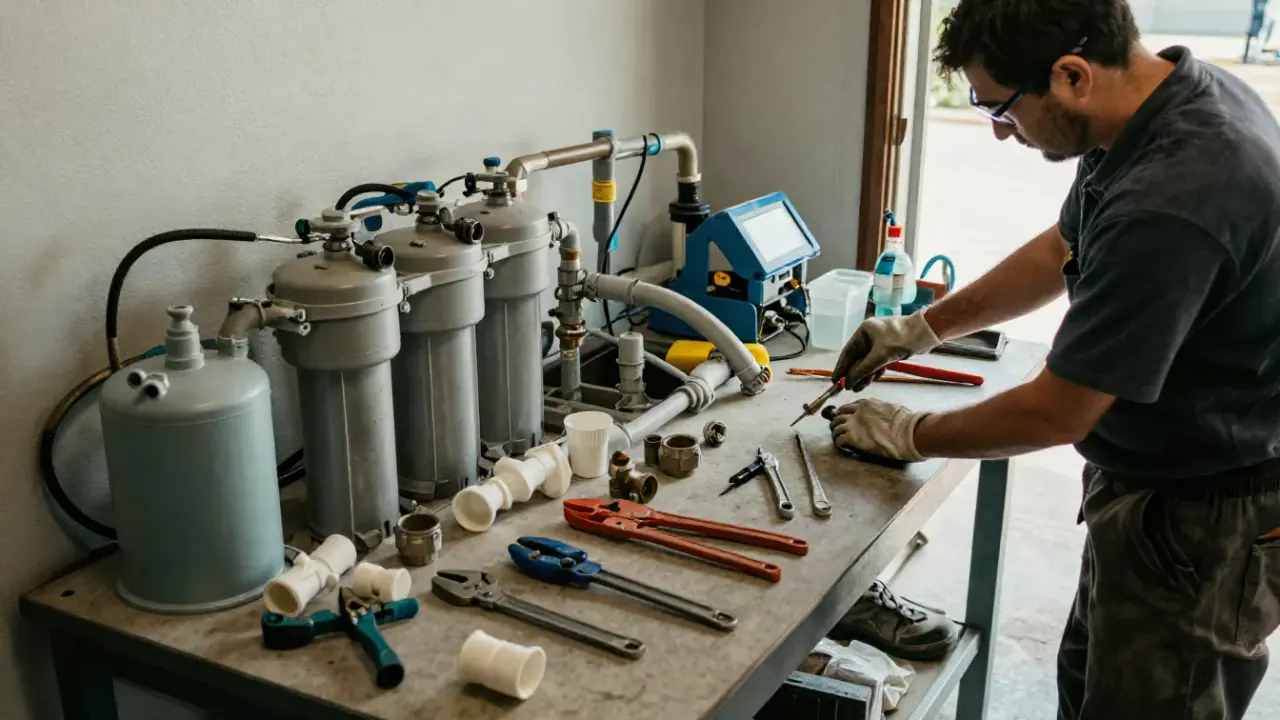
Most Queen Creek households add salt to a softener every 4 to 8 weeks, and a family of four on municipal water usually lands closer to the 4-week mark. That range holds for almost every residential unit we service, from Ironwood Crossing to Encanterra. What pushes you toward 4 weeks instead of 8 is household size, water hardness, and how your control head is programmed. Below we cover how to read your brine tank, how much salt to add, what salt actually costs here in 2026, and the mistakes that quietly wreck softener performance.
The Short Answer for Queen Creek Households
How often should you add salt to a softener is a maintenance question that depends on how fast your unit burns through the salt in the brine tank. Queen Creek water runs hard - we routinely measure 12 to 18 grains per gallon on well and blended sources, and 8 to 11 grains per gallon on treated municipal supply. The harder the water, the more salt the resin bed needs to regenerate, and the faster your salt level drops.
Here is the practical breakdown we give customers:
- 1-2 people: top off every 6 to 8 weeks.
- 3-4 people: every 4 to 6 weeks.
- 5+ people or high-hardness well water: every 3 to 4 weeks.
If you would rather not guess, keep the tank at least half full and check it on the first of every month. That single habit prevents 90% of the no-soft-water calls we get.
How Often Should You Add Salt to a Softener in Queen Creek AZ?
How often should you add salt to a softener in Queen Creek AZ comes down to gallons used, not calendar days. A softener regenerates based on how many gallons pass through the meter before the resin is exhausted. In our service area, a typical four-person home pushes 250 to 350 gallons per day through the unit. At 15 grains per gallon, that is roughly 3,750 to 5,250 grains of hardness removed daily - and about 8 to 12 pounds of salt consumed per regeneration cycle.
Run the math and a four-person Queen Creek household burns through a 40-pound bag of salt every 3 to 5 weeks. That lines up with what we see on service calls: customers in Water Softener in Ironwood Crossing with newer high-efficiency units stretch to 6 weeks, while older 1.5-cubic-foot units with well water need a refill closer to every 3 weeks.
Season matters too. Summer irrigation, pool top-offs, and extra showers push water use up 20 to 30% between May and September. Plan on one extra salt bag per month during peak summer.
How Much Salt Does a Water Softener Use in Queen Creek AZ?
How much salt a water softener uses in Queen Creek AZ depends on three settings: resin tank size, hardness setting, and regeneration type. A standard 1-cubic-foot resin tank regenerates with about 8 to 10 pounds of salt per cycle. A 1.5-cubic-foot tank uses 12 to 15 pounds. A 2-cubic-foot tank, common in larger homes with well water, uses 18 to 22 pounds.
Multiply that by regeneration frequency. A four-person home regenerating every 3 days uses roughly 80 to 100 pounds of salt per month. A two-person home on municipal water regenerating every 6 days uses 40 to 50 pounds per month. Those numbers assume the hardness setting on your control head matches your actual water - a mismatch is the single biggest reason people overuse salt.
We test hardness before we set any unit, and we set it again after a year because Queen Creek water sources shift. If you have never had your water tested, start with Water Hardness Testing Queen Creek AZ - it takes 15 minutes and tells you exactly what your softener should be programmed to.
Signs You Need to Add Salt to Softener in Queen Creek
The clearest sign you need to add salt is a brine tank that is less than one-third full, but your plumbing will tell you before you ever lift the lid. Watch for these:
- Soap that will not lather. If your shampoo and dish soap suddenly need double the amount, the resin is exhausted.
- Spots on glassware and shower doors. White spotting means hard water is getting through.
- Stiff laundry. Towels come out rough and scratchy instead of soft.
- Scale on faucets and the water heater. A chalky film builds up fast when the softener stops working.
- Water feels slippery or filmy. Odd as it sounds, softened water feels slick; hard water feels like it never rinses clean.
If you see scale on fixtures, do not just add salt and move on. Scale that has already formed needs to be addressed - see our Scale Protection for Water Heaters and Fixtures Queen Creek AZ service to keep the damage from spreading to your water heater.
How to Check Salt Level in Water Softener Queen Creek
Checking your salt level takes 30 seconds and you do not need any tools. Here is the routine we teach every customer:
- Lift the brine tank lid (the round or square tank next to the softener).
- Look at the salt. You want it at least half the height of the tank.
- If you see water above the salt line, you have a salt bridge or a brine issue - not a low-salt problem.
- If the salt is crusted into a solid block, break it up with a broom handle before adding more.
- Never fill the tank more than two-thirds full. Salt needs airspace to dissolve properly.
One thing to know: a salt bridge looks like a full tank but is actually hollow underneath. If your softener is not working but the tank looks full, poke the salt with a broom handle. If it crunches and collapses, you had a bridge. That is a brine tank problem, not a salt problem, and it needs Brine Tank Cleaning Queen Creek AZ to fix properly.
Best Salt for Water Softener in Queen Creek Arizona
The best salt for a water softener in Queen Creek Arizona is high-purity evaporated or solar salt with a purity rating above 99%. That purity matters here because our water already carries high mineral content - you do not want to add more sediment to the brine tank.
Your three options:
- Evaporated salt pellets: 99.5%+ pure, dissolve cleanly, leave almost no residue. Best choice for most Queen Creek homes. About $8 to $12 per 40-pound bag.
- Solar salt crystals: 99.5% pure, slightly slower to dissolve, works well in high-humidity areas. $6 to $10 per bag.
- Rock salt: 95 to 98% pure, leaves sediment that builds up in the brine tank. We only recommend it for older units where cost is the deciding factor.
Skip the potassium chloride unless your doctor has told you to avoid sodium. It costs two to three times more and does not soften any better.
Water Softener Salt Cost Queen Creek AZ
Water softener salt cost in Queen Creek AZ runs $6 to $14 per 40-pound bag in 2026, depending on type and where you buy it. Big-box stores and farm supply shops in the East Valley are the cheapest at $6 to $9 for solar crystals. Evaporated pellets run $8 to $12. Potassium chloride runs $25 to $35 per bag.
Annual salt cost for a typical four-person Queen Creek home lands between $120 and $220 per year. That is roughly $10 to $18 per month - cheap insurance compared to a $1,200 water heater replacement caused by scale, or a $3,000 repipe from hard-water corrosion.
Buy salt in bulk when you can. A pallet of 40-pound bags drops the per-bag price by 15 to 25%, and salt does not expire if you store it dry.
Common Mistakes We See in Brine Tanks
The most common mistake we find on service calls is overfilling the brine tank. Customers think more salt equals softer water. It does not. Salt above the two-thirds line does not dissolve efficiently, and it can compact into a solid block that stops the unit from regenerating at all.
Other mistakes:
- Ignoring a salt bridge. Looks full, works empty. Always poke the salt before adding more.
- Mixing salt types. Switching between rock salt and pellets leaves sediment layers that clog the brine valve.
- Never cleaning the tank. Every 12 to 18 months, the brine tank needs a full clean-out. Sediment and undissolved salt accumulate and reduce efficiency.
- Setting hardness too high. Programming 25 grains when your water is 12 grains doubles your salt use for no benefit.
- Letting the tank run dry. Running a softener with no salt for weeks forces the resin to work without regeneration, and it can foul permanently.
We see the salt bridge problem most often in Water Softener in Queen Creek Station and other neighborhoods with newer construction, where softeners sit in garages that hit 110°F in summer. Heat accelerates salt compaction. Check those tanks monthly from June through September.
When to Call a Professional
Call us when the tank is full of salt but the water is still hard. That points to a mechanical failure - a stuck brine valve, a failed control head, or resin that has been exhausted past recovery. Adding more salt will not fix any of those.
Other reasons to call Queen Creek Water Softener:
- Salt bridges that reform within weeks of breaking them up.
- Water leaking from the brine tank or around the control head.
- The unit regenerates constantly, or never regenerates at all.
- Salt use has doubled without a change in household size.
- The softener is more than 12 years old and repairs are stacking up.
We diagnose the issue on the first visit and give you a flat price before we start. Most salt-related service calls are resolved the same day.
Frequently Asked Questions
How often should I add salt to my water softener in Queen Creek AZ?
Every 4 to 8 weeks for most Queen Creek homes. A family of four on municipal water typically refills every 4 to 6 weeks; a two-person household stretches to 6 to 8 weeks. High-hardness well water can require a refill every 3 weeks.
How much salt should I put in my softener in Queen Creek Arizona?
Fill the brine tank to no more than two-thirds full - usually 80 to 120 pounds of salt. Never top it off completely. Salt needs airspace and water circulation to dissolve and form brine properly.
What happens if I don't add salt to my softener in Queen Creek?
The resin stops regenerating and hard water passes straight through. Within 2 to 3 weeks you will see spots on dishes, stiff laundry, and scale forming on fixtures and your water heater. Long-term, the resin can foul permanently and need replacement.
What type of salt is best for water softeners in Queen Creek?
Evaporated salt pellets with 99.5%+ purity. They dissolve cleanly and leave minimal sediment in the brine tank. Solar salt crystals are a close second and cost a dollar or two less per bag. Avoid rock salt unless your unit is older and cost is the deciding factor.
How do I know when to add salt to my softener in Queen Creek?
Check the brine tank monthly. If the salt level is below half the tank height, add more. You will also notice hard-water signs - soap that will not lather, spots on glassware, and stiff towels - before the tank runs completely dry.
Get Help with Water Softener in Queen Creek
If your softener is eating salt, not softening water, or you just want a professional to set the hardness and regeneration schedule correctly, our team handles it. We serve every neighborhood in Queen Creek and the surrounding East Valley.
Call Queen Creek Water Softener at (480) 337-3003 to schedule a service visit. We will test your water, inspect the brine tank and control head, and get your unit running the way it should.