How Hard Water Affects Faucets, Showerheads and Appliances
Queen Creek water runs 12 to 18 grains per gallon. Here's exactly how that hardness eats faucets, showerheads, and appliances - and what it costs you.
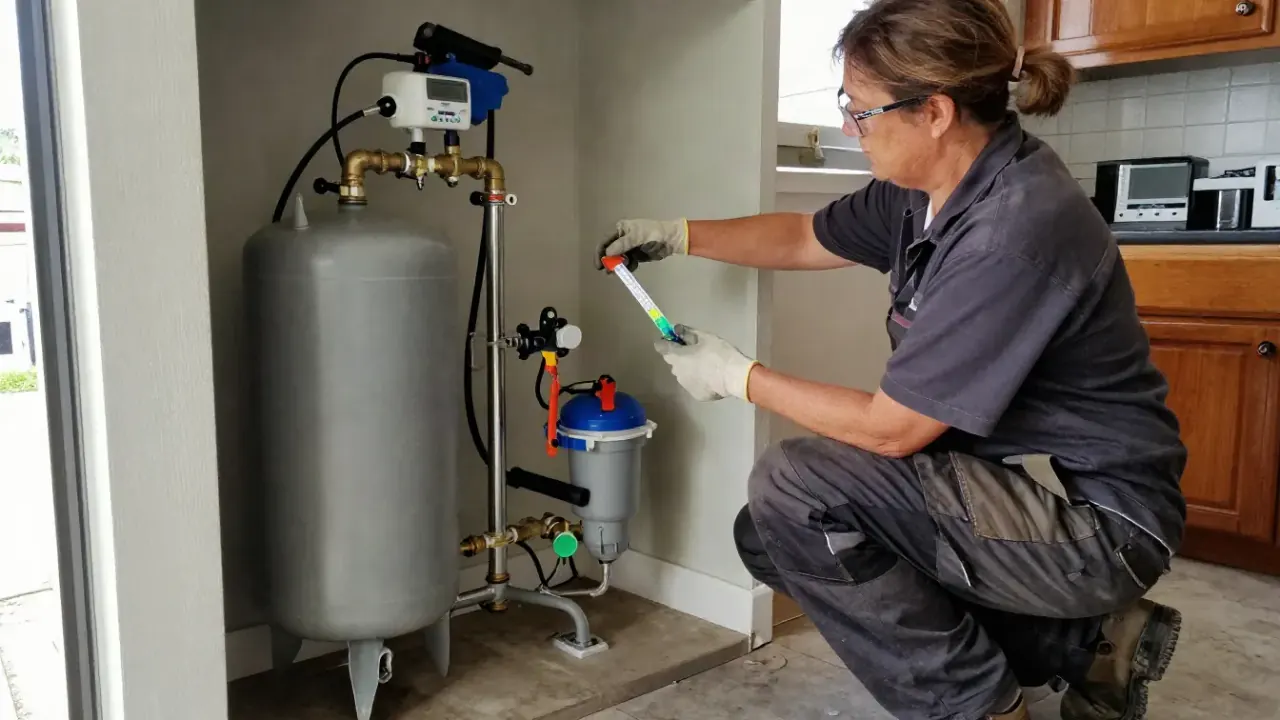
Hard water affects faucets, showerheads, and appliances by depositing calcium and magnesium scale on every surface water touches - and in Queen Creek, that scale builds fast. Our municipal and well water runs 12 to 18 grains per gallon, which is roughly three times the 3.5 gpg threshold the U.S. Geological Survey uses to classify water as hard. That single fact explains why your showerhead clogs in eight months instead of eight years.
Hard water effects on fixtures and appliances is not a cosmetic problem. Scale insulates heating elements, narrows pipes, and forces motors to work harder until they quit. Below we break down exactly what is happening inside your home, what it costs to fix in 2026, and how to stop the damage before it starts.
Why Queen Creek Water Is So Hard
Queen Creek water is hard because it travels through limestone and calcite-rich desert geology before it reaches your meter. Every gallon picks up dissolved calcium and magnesium. When that water evaporates or heats up, the minerals drop out as solid scale - the white crust you see on faucet aerators and inside your coffee maker.
Hardness varies a bit depending on whether you are on a private well or a municipal line. Wells in the San Tan Valley and Queen Creek corridor often test 15 to 22 gpg. Treated municipal water from the Central Arizona Project typically lands between 10 and 14 gpg. Either way, you are well above the point where scale becomes a maintenance problem.
If you have never tested your water, a water hardness test Queen Creek takes about 20 minutes and tells you exactly what you are dealing with. We test at the tap, not at the meter, because that is where the damage happens.
How Hard Water Affects Faucets and Showerheads
Hard water faucet problems start small - a stiff handle, a slightly reduced stream - and end with a faucet you have to replace. Scale forms on the cartridge, the aerator screen, and the valve seat. Each layer narrows the opening and increases friction until the handle grinds or drips.
Showerhead scale buildup is even more obvious. Those crusty white deposits on the nozzles are calcium carbonate. They block individual jets one at a time, so the spray pattern degrades gradually. By the time you notice, 30 to 50 percent of the nozzles may be plugged.
Here is what we see on a typical service call in a Queen Creek home that has never had a softener:
- Faucet aerators: fully crusted within 6 to 10 months
- Showerhead nozzles: 40 to 60 percent blocked at the 18-month mark
- Faucet cartridges: stiff or failing at 2 to 3 years instead of 8 to 10
- Toilet fill valves: scaled and slow-filling within 2 years
You can slow this down by soaking removable showerheads in white vinegar overnight, but that only treats the symptom. The scale is still forming inside the valve body where you cannot reach it. For homeowners dealing with this across Water Softener in Ironwood Crossing, we usually find the original builder-grade fixtures have already been replaced once before the softener goes in.
How Hard Water Damages Appliances
Hard water damage to appliances is where the real money goes. Scale does not just sit on surfaces - it insulates. On a heating element, even a 1/16-inch layer of scale forces the element to run hotter and longer to reach the same temperature. That extra heat is what kills appliances early.
Washing machine
Hard water effects on washing machine performance show up two ways: detergent stops dissolving properly, and the inlet valve screen clogs. You end up using 30 to 50 percent more detergent to get the same clean, and the machine works harder on every fill cycle. A washer that should last 11 years often fails at 6 or 7 in a hard-water home.
Dishwasher
Dishwashers are the first appliance to show visible scale. The heating element gets coated, the spray arms clog, and glasses come out with a white film. In Queen Creek, a dishwasher with no softener typically needs a descaling service every 12 to 18 months.
Water heater
This is the big one. A tank water heater in 15-gpg water accumulates 2 to 5 pounds of scale per year. That sediment layer at the bottom traps heat, causes popping sounds, and forces the burner to run longer. A 10-year tank often fails at year 5 or 6. Tankless units are even more sensitive - scale narrows the heat exchanger and can void the manufacturer warranty if you have not been descaling annually.
Hard water appliance lifespan is the clearest measure of the problem. Across the board, we see appliances in unsoftened Queen Creek homes lasting 40 to 60 percent less time than the manufacturer's rated life. If you want to protect the water heater specifically, water heater descaling Queen Creek AZ is a service we run every 12 months on tankless systems.
What Hard Water Costs You Every Year in Queen Creek
Hard water plumbing issues add up to real money, even if you never see a single repair bill. Here is a realistic 2026 breakdown for a typical 2,200-square-foot Queen Creek home with four people:
- Extra detergent and soap: $180 to $300 per year
- Replacing faucets and showerheads early: $250 to $600 per year, averaged
- Water heater descaling or early replacement: $150 to $400 per year, averaged
- Dishwasher and washer repairs: $200 to $500 per year, averaged
- Increased water heating energy: $80 to $150 per year
That is $860 to $1,950 per year in hard water damage to appliances and fixtures. A quality softener installed in 2026 runs $1,800 to $3,500 depending on size and configuration, plus $100 to $200 per year in salt and maintenance. Most homeowners break even in 18 to 24 months.
If you want to see the full range of options, our Water Softener Queen Creek AZ page covers sizing, installation, and what we recommend for different home types.
Common Mistakes Homeowners Make With Hard Water
The most common mistake is waiting until something breaks. Scale damage is cumulative - by the time your water heater fails, you have already paid for five years of inefficiency. Fixing the water is almost always cheaper than fixing the appliances.
Other mistakes we see regularly:
- Using CLR or vinegar on everything. These work on surface scale but do nothing for the inside of a valve body or a heating element. Overuse can also damage rubber seals.
- Setting the softener too low. If your water is 16 gpg and you program the softener for 8 gpg, you are only removing half the hardness. The rest still scales your fixtures.
- Skipping the brine tank. Salt bridges and mushy brine stop the softener from regenerating properly. We recommend a brine tank cleaning Queen Creek every 12 to 18 months.
- Assuming a filter softens water. A standard carbon filter improves taste but does not remove calcium or magnesium. Only ion exchange or salt-free conditioning addresses hardness.
- Ignoring the water heater. Even with a softener, the water heater should be flushed annually. Sediment still accumulates from other sources.
How to Protect Faucets and Appliances From Hard Water
Protecting faucets and appliances from hard water comes down to one thing: remove the minerals before they reach the fixture. Everything else is a band-aid.
Here is the order we recommend to Queen Creek homeowners:
- Test your water. Know your actual grains per gallon. Guessing leads to undersized equipment.
- Install a properly sized softener. For a family of four in 15-gpg water, you need a 32,000 to 40,000 grain unit. Undersizing is the number one reason softeners underperform.
- Add whole-house filtration if you are on a well. Sediment and iron will foul a softener resin bed quickly. A whole house water filter Queen Creek upstream of the softener protects the resin and extends its life.
- Descale the water heater annually. Even softened water leaves some sediment. A yearly flush keeps the tank efficient.
- Clean aerators and showerheads every 6 months. A 30-minute vinegar soak keeps the visible fixtures flowing freely.
For homes in the newer developments along the Hunt Highway corridor, we often recommend a salt-free option as a first step because there is no brine discharge to manage. If that fits your situation, our salt-free water conditioner Queen Creek page explains how conditioning differs from traditional softening.
When to Call a Professional
Call a professional when you see scale on more than one fixture, when your water heater starts popping, or when you are replacing faucets more often than every five years. Those are signs the problem is system-wide, not isolated.
We handle the full scope: testing, sizing, installation, and ongoing service. If your softener is already in place but not keeping up, we can check the resin bed, the control valve, and the brine tank in a single visit. Sometimes the fix is a resin tank replacement Queen Creek; sometimes it is just a settings change. We will tell you which one you actually need.
For older homes in Water Softener in Queen Creek Station, we also see original plumbing that was never sized for a softener loop. We can usually tie in without major repiping, but it is worth checking before you buy equipment.
Frequently Asked Questions
How does hard water affect faucets and showerheads in Queen Creek AZ?
Hard water leaves calcium and magnesium scale on aerators, cartridges, and shower nozzles. In Queen Creek's 12 to 18 gpg water, aerators crust over in 6 to 10 months and showerheads lose 40 to 60 percent of their flow within 18 months. Cartridges stiffen and fail 2 to 3 years early.
Can hard water damage appliances in Queen Creek Arizona?
Yes. Scale insulates heating elements and clogs inlet valves, forcing appliances to run hotter and longer. We routinely see washers, dishwashers, and water heaters fail 40 to 60 percent earlier than their rated lifespan in unsoftened Queen Creek homes. The damage is cumulative and starts on day one.
How do I remove scale from showerheads in Queen Creek?
Unscrew the showerhead and soak it in white vinegar for 8 to 12 hours, then scrub the nozzles with a stiff brush. That clears surface scale. For scale inside the valve body or on a fixed shower arm, you need a softener - vinegar cannot reach those surfaces. Repeat every 6 months.
Does hard water shorten appliance life in Queen Creek?
It shortens it significantly. A tank water heater rated for 10 years often fails at 5 or 6 in 15-gpg water. Washing machines drop from 11 years to 6 or 7. Dishwashers need descaling every 12 to 18 months. A softener typically restores 80 to 90 percent of the rated lifespan.
What is the best way to protect appliances from hard water in Queen Creek?
A correctly sized ion exchange softener is the most effective protection. For a family of four in 15-gpg water, that means a 32,000 to 40,000 grain unit. Add annual water heater descaling and 6-month fixture cleaning. Together, those three habits prevent the vast majority of scale damage.
Get Help With Water Softener in Queen Creek
If your fixtures are crusting over and your appliances are quitting early, the water is the problem - and it is fixable. We test, size, install, and service softeners for homes across Queen Creek, San Tan Valley, and Gilbert.
Call Queen Creek Water Softener at (480) 337-3003 to schedule a water hardness test and get a straight answer on what your home actually needs.